Every new business faces the same early challenge: how to get funding without destroying cash flow. Grants look attractive because they do not require repayment. Loans look practical because they are faster and flexible. In 2026, many founders ask the same question: are grants actually better than loans for new businesses?
The honest answer is not yes or no.
Grants and loans serve different purposes at different stages.
This article explains when grants are better, when loans are better, and how new businesses should choose based on risk, timing, and survival.
Why this question matters for new businesses
New businesses operate with limited margin for error. Revenue is uncertain. Expenses are fixed. One poor funding decision can end the business before it stabilizes.
Funding affects:
- Cash flow pressure
- Speed of growth
- Risk exposure
- Long-term flexibility
Choosing the wrong funding type often causes more harm than starting small.
What grants offer new businesses
Grants provide non-repayable capital when conditions are met. For new businesses, this removes one major risk: monthly repayment.
Grants are best seen as risk-protection funding.
They are commonly used for:
- Product development
- Innovation and research
- Equipment and tools
- Training and systems
- Early-stage setup
Because there is no repayment, grants protect survival during fragile early stages.
The downside is access. Grants are competitive, slow, and restrictive. Funds must be used exactly as approved.
What loans offer new businesses
Loans provide capital that must be repaid with interest. They are designed for speed and execution, not protection.
Loans work best when:
- Revenue is predictable
- The business can service repayments
- Capital directly increases sales
- Timing matters
For new businesses without steady cash flow, loans increase pressure. One slow month can create stress immediately.
Loans reward discipline. They punish uncertainty.
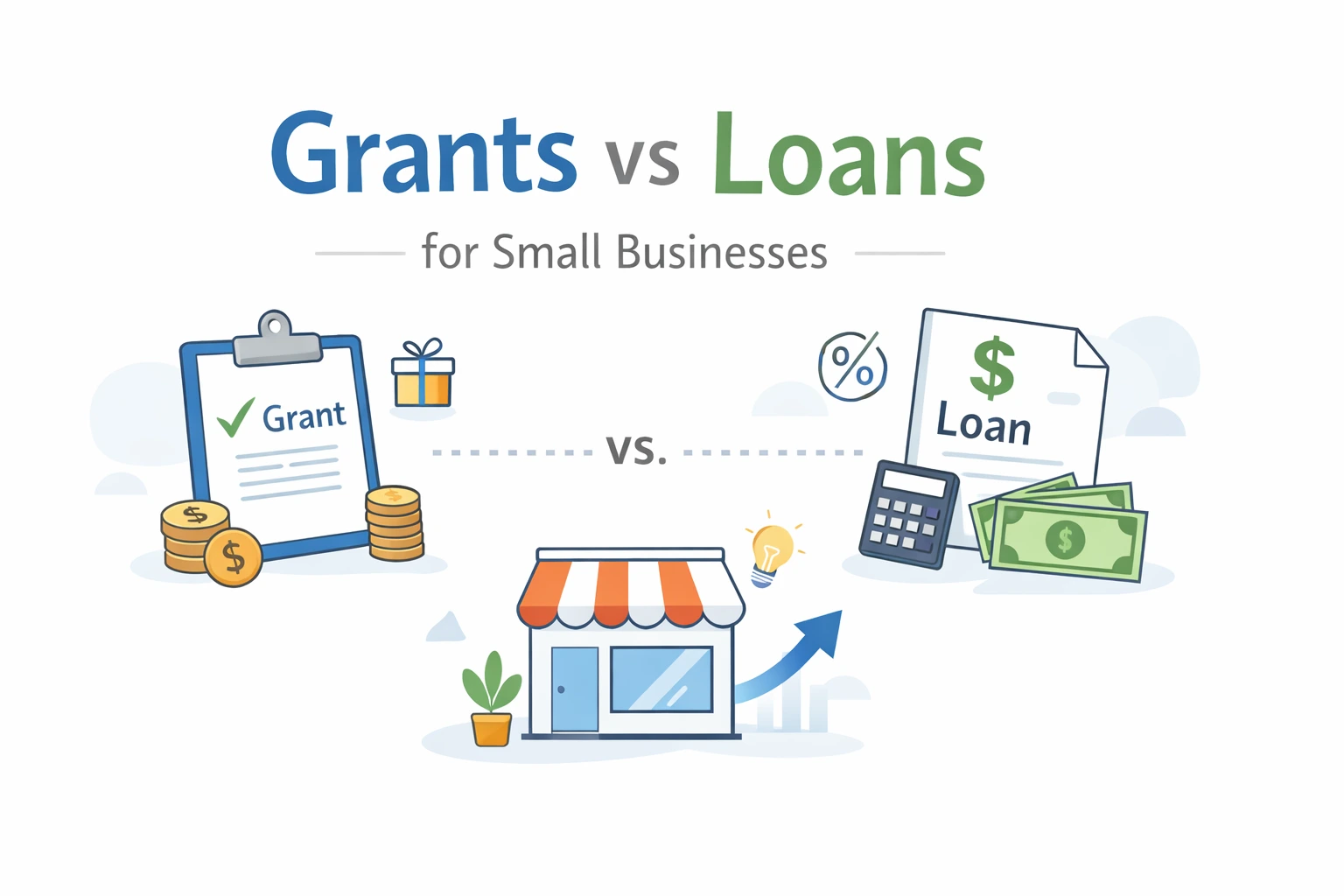
Grants vs loans: direct comparison for new businesses
| Factor | Grants | Loans |
|---|---|---|
| Repayment | None if compliant | Required |
| Cash-flow pressure | Low | High |
| Speed | Slow | Fast |
| Flexibility | Limited | High |
| Financial risk | Low | Medium to high |
| Best for | Stability | Revenue growth |
This table highlights a key truth.
Grants protect survival.
Loans accelerate growth.
When grants are better for new businesses
Grants are usually the better option when the business is still fragile.
Grants make more sense if:
- The business is pre-revenue or early-stage
- Repayment would threaten survival
- Funding is for development, not scaling
- Time flexibility exists
For many startups, grants replace early seed capital without debt or dilution.
When loans are better for new businesses
Loans become useful when the business can carry them.
Loans make more sense if:
- Sales are already happening
- Cash flow is reliable
- Funding will directly increase revenue
- The business understands its numbers
Loans should not fund experimentation. They should fund execution.
The mistake new businesses often make
The most common mistake is taking loans too early.
Many new businesses borrow before revenue stabilizes. This creates repayment stress and forces poor decisions.
Another mistake is waiting endlessly for grants while the business stalls.
The best funding choice balances patience with momentum.
A smarter approach for new businesses
Many successful businesses use grants and loans in stages.
A common path looks like this:
- Grants for development and setup
- Revenue traction
- Small loans for expansion
This approach reduces risk early and uses debt only when the business can carry it.
How to choose the right option for your business
Ask these questions honestly:
Can the business survive fixed repayments right now?
Will this funding generate revenue quickly?
Is flexibility more important than cost?
Does this funding reduce or increase stress?
Clear answers make the decision obvious.
Final perspective
Grants are often better for new businesses at the beginning. They protect cash flow and reduce failure risk.
Loans are better after stability appears. They support growth, not survival.
The best funding strategy is not choosing one forever.
It is choosing the right tool at the right stage.
Frequently Asked Questions (FAQ)
Are grants always better than loans for startups?
No. Grants are better for early stability. Loans are better when revenue is predictable and growth is the goal.
Can a new business survive using only grants?
Yes, for development and early operations. Long-term growth usually requires revenue or additional funding later.
Why are loans risky for new businesses?
Loans create fixed repayments. Without stable cash flow, this pressure can damage operations quickly.
Are grants hard to get for new businesses?
Yes. Grants are competitive and selective. Strong planning and alignment improve success.
Can a new business use both grants and loans?
Yes. Many businesses use grants first and loans later once cash flow improves.
Which funding option is faster for new businesses?
Loans are usually faster. Grants take longer due to review and approval processes.
Do grants limit how money is spent?
Yes. Most grants restrict spending to approved project costs.
What is the safest funding choice for a new business?
Grants and bootstrapping are safest because they avoid repayment pressure.