Latest Update (July 2026): This guide has been reviewed and refreshed to reflect the current startup funding landscape, including higher financing costs, stronger investor scrutiny, and the continued importance of choosing the right funding strategy.
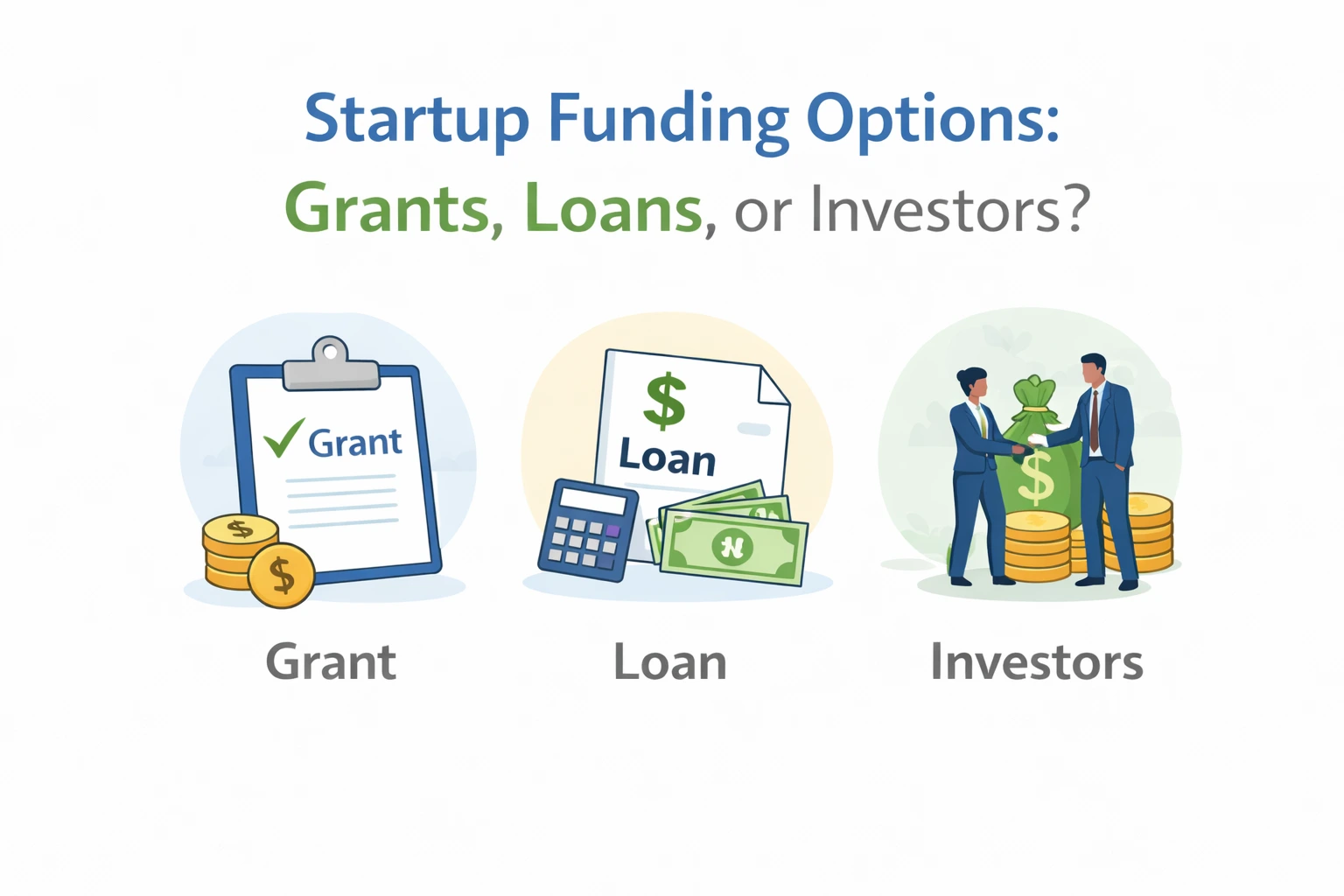
Every startup eventually reaches the same crossroads: how to fund the next stage of growth. Whether the money comes from grants, loans, or investors, that decision can influence your business for years. Grants remove repayment pressure, loans provide speed and flexibility, while investors contribute capital, experience, and networks in exchange for equity.
In 2026, funding decisions are more strategic than ever. Costs are high. Competition is intense. Cash-flow mistakes are unforgiving. The right funding option is not about preference. It is about fit.
This guide explains startup funding options in clear, commercial terms. It focuses on risk, cost, control, and growth impact, not hype.
Why funding choice matters for startups
Startups operate with limited buffers. One wrong decision can stall growth or force shutdown.
Funding affects:
- Cash flow stability
- Ownership and control
- Speed of execution
- Long-term pressure on the business
Choosing the wrong funding type often hurts more than choosing no funding at all.
Grants as a startup funding option
Grants provide capital that does not require repayment when conditions are met. This makes them attractive for startups with limited revenue.
Grants are best viewed as risk protection, not fast growth fuel.
They are commonly used for:
- Innovation and product development
- Research and validation
- Skills and systems development
- Early-stage capacity building
The downside is time and restriction. Grant applications are slow. Approval is competitive. Funds are usually limited to specific uses.
Grants work best for startups that can wait and operate with structure.
Loans as a startup funding option
Loans provide immediate access to capital with a clear repayment schedule. They are designed for execution speed.
Loans are most useful when:
- Revenue is predictable
- Capital will directly increase sales
- Timing is critical
- Spending flexibility is required
The risk is fixed repayment. Startups without steady cash flow can struggle to service loans, especially during slow periods.
Loans reward discipline. They punish uncertainty.
Investors as a startup funding option
Investor funding exchanges capital for ownership. There is no repayment, but control is shared.
Investors bring more than money. Many offer mentorship, networks, and strategic support.
Investor funding works best for startups that:
- Have high growth potential
- Can scale rapidly
- Are comfortable with dilution
- Aim for long-term expansion
The cost is equity. Decisions are no longer yours alone.
Comparing grants, loans, and investors
| Factor | Grants | Loans | Investors |
| Repayment | None if compliant | Required | None |
| Ownership loss | No | No | Yes |
| Speed | Slow | Fast | Medium |
| Flexibility | Limited | High | Medium |
| Financial risk | Low | High | Medium |
| Growth pressure | Low | High | High |
| Best for | Stability | Revenue growth | Scale |
This comparison highlights a core truth.
Grants protect survival.
Loans accelerate execution.
Investors push scale.
When grants make the most sense for startups
Grants are ideal when survival and stability matter more than speed.
They work well if:
- The startup is pre-revenue or early-stage
- Repayment would threaten operations
- The project has clear, measurable outcomes
- Time flexibility exists
Grants are especially useful for building foundations, not chasing rapid expansion.
When loans make the most sense for startups
Loans make sense when capital directly generates income.
They work best if:
- Sales are already happening
- Cash flow is reliable
- Growth opportunities are time-sensitive
- The startup can handle monthly repayments
Loans should fund revenue, not experimentation.
When investors make the most sense for startups
Investors are best when scale is the goal.
They are suitable if:
- The startup targets large markets
- Rapid growth is expected
- The founder accepts shared control
- Long-term value matters more than short-term cash flow
Investor funding fits ambition, not caution.
The mistake many startups make
The biggest mistake is choosing funding based on availability instead of fit.
Some startups chase grants they do not need. Others take loans too early. Many give up equity before proving traction.
Funding should follow strategy, not desperation.
A smarter approach: staged funding
Successful startups often use funding in stages.
A common pattern includes:
- Grants for early development
- Small loans for operational growth
- Investors for scaling proven models
This approach reduces risk while preserving control.
How to choose the right option
Ask these questions honestly:
Can the business survive fixed repayments?
Is speed more important than control?
Am I willing to share ownership?
Does this funding create revenue or pressure?
Clear answers lead to better decisions.
Final perspective for founders
No funding option is universally best.
Grants reduce risk but limit flexibility.
Loans increase speed but raise pressure.
Investors fuel scale but reduce control.
The right choice depends on stage, cash flow, and ambition.
Funding should support progress without threatening survival.
Frequently Asked Questions (FAQ)
Are grants better than loans for startups?
Grants are better for reducing risk and preserving cash flow, especially for early-stage startups. Loans are better when revenue already exists and can cover repayments.
Can startups get loans without revenue?
It is possible, but risky. Without predictable income, loan repayments can strain operations and increase failure risk.
Do investors require repayment like loans?
No. Investors earn returns through ownership value, not monthly repayment. The cost is equity and shared control.
Which funding option is fastest for startups?
Loans are usually the fastest. Grants are the slowest. Investor funding sits in between.
Is it bad to give up equity early?
Giving up equity too early can limit future control and valuation. It should match growth potential and long-term goals.
Can startups combine grants, loans, and investors?
Yes. Many successful startups use grants early, loans for revenue growth, and investors for scale.
What funding option has the lowest risk?
Grants carry the lowest financial risk because there is no repayment. They still require compliance and patience.
Which option is best for long-term growth?
Investors support long-term scale, but only if the startup is ready to grow rapidly and share control.