Business Grants vs Loans: Which Funding Option Is Better in 2026?
Choosing between a grant and a loan is one of the most important financial decisions a business owner can make. Grants provide non-repayable funding but are competitive and slower to secure. Loans offer faster access to capital and greater flexibility, but they also create repayment obligations. In today’s funding environment, the right choice depends on your cash flow, growth plans, and tolerance for financial risk.
Across global markets, small businesses still face tighter funding conditions than before. Interest rates remain elevated in many regions. Lenders are cautious. Competition for non-repayable funding has increased. This makes the grants-versus-loans decision more critical than ever.
The real question is not which is cheaper.
The question is which funding type matches your business reality.
This guide explains grants and loans in clear, commercial terms. It is written for small businesses operating across multiple markets, not one country. The goal is smarter capital decisions, not theory.
Why this question matters more now
Many small businesses are growing in uncertain conditions. Costs remain high. Credit approval is stricter. Cash flow mistakes are punished faster than before.
Funding now affects more than expansion. It affects survival.
In 2026, business owners are asking harder questions:
Can this funding carry itself?
What happens during a slow quarter?
Does this money create growth or stress?
Answering these questions correctly separates stable businesses from fragile ones.
Grants and loans are not opposites
Grants and loans solve different problems. Treating them as rivals leads to poor decisions.
Grants reduce financial risk.
Loans increase execution speed.
One protects cash.
The other multiplies momentum.
Understanding this difference is the foundation of smart funding strategy.
What business grants really offer
A business grant provides capital without repayment, as long as conditions are met. This makes grants attractive for owners who want to grow without monthly pressure.
Grants are best viewed as risk reducers, not growth accelerators.
They work well for:
- Innovation projects
- Systems and infrastructure
- Long-term capability building
- Businesses with limited repayment tolerance
However, grants demand patience. Approval timelines are long. Reporting requirements are strict. Spending flexibility is limited.
Grants reward planning, not speed.
What business loans really provide
Loans offer immediate access to capital. They are designed for action, not waiting.
Loans are growth amplifiers when used correctly.
They work best for:
- Inventory expansion
- Equipment purchases
- Hiring for revenue roles
- Scaling proven products or services
The trade-off is repayment risk. Every loan adds fixed costs. If revenue slows, pressure increases quickly.
Loans reward execution discipline.
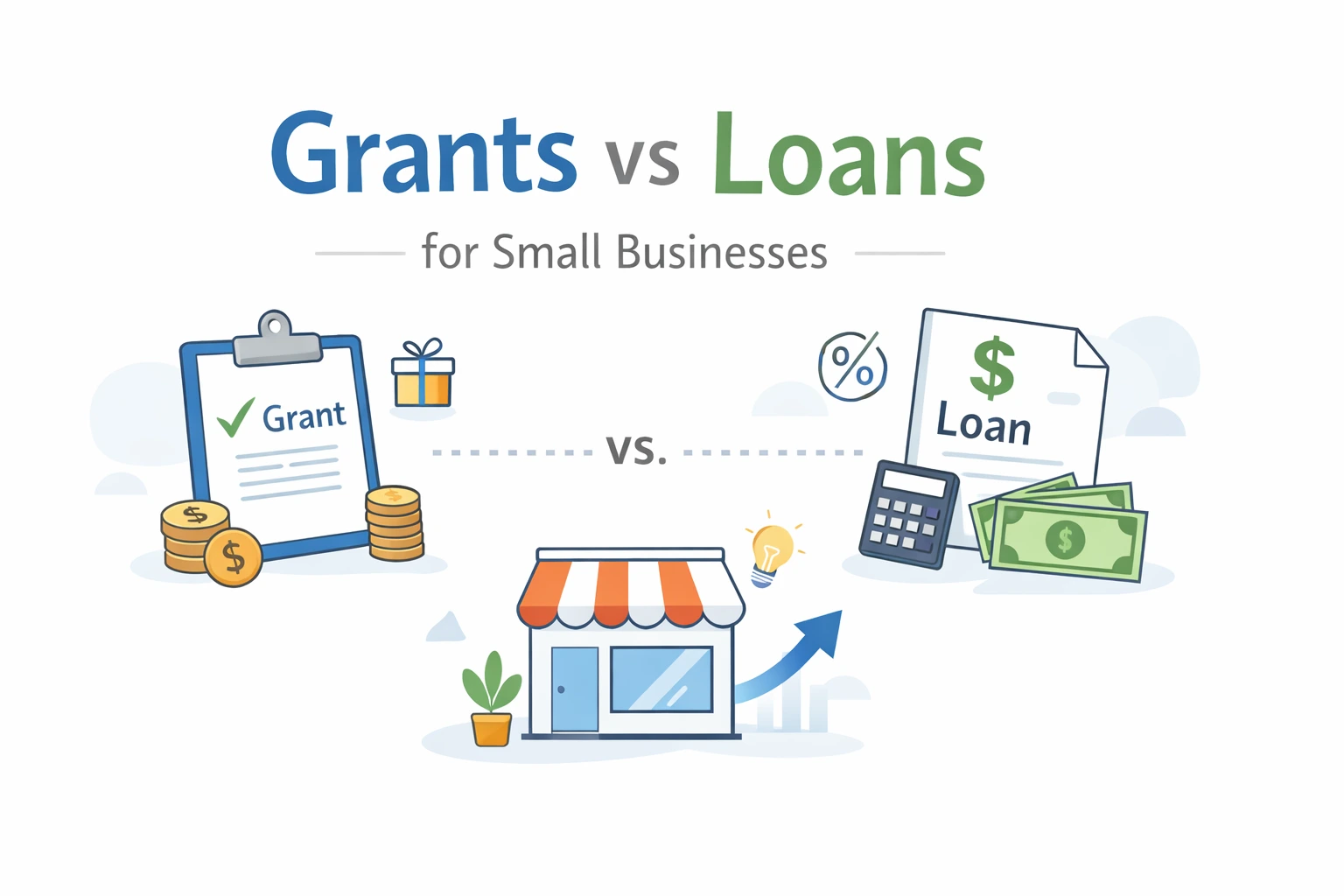
Grants vs Loans: clear comparison
| Decision Factor | Grants | Loans |
| Repayment pressure | None if compliant | Ongoing monthly obligation |
| Access speed | Slow | Fast |
| Use of funds | Restricted | Flexible |
| Financial risk | Low | Medium to high |
| Best use case | Stability and capability | Revenue-driven expansion |
This table highlights a key truth.
Grants protect the downside. Loans push the upside.
When grants make more sense
Grants are the better option when preserving cash flow matters more than moving fast.
They fit businesses that:
- Can wait for funding decisions
- Have clear, measurable project outcomes
- Prefer lower financial risk
- Operate with thin or unstable margins
If repayment would threaten operations during slow months, grants are safer.
The cost is time and flexibility.
When loans make more sense
Loans are better when opportunity has a deadline.
They fit businesses that:
- Generate predictable revenue
- Understand their unit economics
- Have a clear repayment plan
- Need capital immediately
If funding directly produces revenue within months, loans can outperform grants despite interest costs.
The cost is pressure and discipline.
The real trade-off most owners miss
Most business owners compare interest rates. That is incomplete.
The real comparison is:
repayment risk versus growth speed.
If growth is slow or uncertain, repayment risk dominates.
If growth is fast and reliable, speed dominates.
Funding should match this balance.
Why many businesses now combine both
In 2026, more small businesses use funding stacks.
This means combining grants and loans strategically.
Common patterns include:
- Grants for systems, loans for operations
- Grants for innovation, loans for scale
- Loans for speed while grants are pending
This approach spreads risk and improves cash flow resilience.
A fast decision framework
Ask yourself three questions:
Can my business survive repayment during a slow quarter?
How quickly does funding turn into revenue?
How flexible must spending be?
Clear answers lead to the right choice.
Preparation still decides outcomes
Whether applying for grants or loans, preparation matters more than intent.
Businesses that secure funding usually have:
- Clean financial records
- Clear use-of-funds plans
- Realistic cash-flow forecasts
- Simple growth narratives
Funding favors clarity.
Final perspective for 2026
Grants and loans are tools. Neither is universally better.
The best funding decision aligns with:
- Cash flow reality
- Growth timing
- Risk tolerance
- Execution capacity
Capital should support growth, not create anxiety.
Before choosing, compare options carefully. Look beyond headline terms. Focus on pressure, flexibility, and payoff.