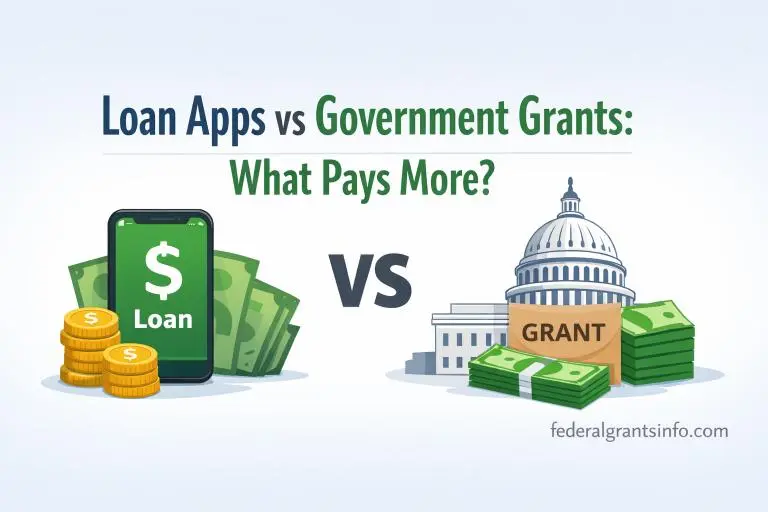
When businesses need money fast, loan apps and government grants often appear as two very different options. Loan apps promise instant cash. Government grants promise non-repayable funding. Many entrepreneurs ask a simple question: which one actually pays more?
In 2026, the real answer is not about headline amounts. It is about net value, repayment pressure, and long-term business impact.
This article explains how loan apps and government grants really compare, what “pays more” actually means, and which option leaves a business stronger after the money is used.
What “pays more” really means in business funding
Most people think “pays more” means higher cash received. That is incomplete.
For businesses, real payout means:
- How much money you keep
- How much pressure the funding creates
- How it affects cash flow
- Whether it supports growth or creates stress
Money received minus money repaid is the true measure.
What loan apps really offer
Loan apps provide short-term digital loans with fast approval. Funds are often disbursed within hours or days.
Loan apps are designed for:
- Emergency cash needs
- Short-term working capital
- Immediate expenses
The advantage is speed. There is little paperwork. Approval is quick.
The downside is cost. Loan apps often charge:
- High interest
- Service and processing fees
- Short repayment periods
Although the cash arrives fast, a large portion must be repaid quickly.
What government grants really offer
Government grants provide non-repayable funding when conditions are met. There is no interest and no repayment.
Grants are designed to support:
- Business development
- Innovation and equipment
- Training and systems
- Early-stage growth
The advantage is clear. The business keeps the full amount.
The downside is access. Grants are competitive, slow, and structured. Funds are restricted to approved uses. Reporting is required.
Loan apps vs government grants: direct comparison
| Factor | Loan Apps | Government Grants |
|---|---|---|
| Repayment | Required | None if compliant |
| Interest and fees | High | None |
| Speed | Very fast | Slow |
| Cash kept long-term | Low | High |
| Cash-flow pressure | High | Low |
| Use of funds | Flexible | Restricted |
| Financial risk | High | Low |
This comparison shows the core truth.
Loan apps pay fast.
Government grants pay more.
Which option gives more net value?
In most cases, government grants pay more in net terms.
With grants:
- You keep 100% of approved funds
- No repayment reduces future pressure
- Cash flow stays stable
With loan apps:
- You repay principal plus fees
- Net cash retained is much lower
- Repayment pressure reduces flexibility
Even if a loan app provides quick access, the business gives back a large portion shortly after.
When loan apps may still feel like they pay more
Loan apps may seem better when:
- Money is needed urgently
- The business cannot wait
- The amount required is very small
- Repayment can be handled quickly
In these cases, speed outweighs net value. But this is a short-term trade-off, not a long-term advantage.
When government grants clearly pay more
Government grants pay more when:
- The business can wait for approval
- Funding is for development or assets
- Repayment risk must be avoided
- Cash flow is fragile
In these situations, grants deliver higher real value because nothing is paid back.
The hidden cost difference
Loan apps carry hidden costs:
- Daily or weekly repayment pressure
- Reduced cash flow for operations
- Risk of repeat borrowing
Government grants carry hidden costs too:
- Time spent applying
- Reporting and compliance work
However, time cost rarely equals the financial cost of high-interest repayment.
Can businesses use both?
Yes. Some businesses use loan apps only as temporary bridges, while applying for grants in parallel.
A safer approach is:
- Use grants for planned expenses
- Avoid loan apps except for true emergencies
- Never rely on loan apps for growth
Loan apps are survival tools. Grants are growth tools.
Which option supports business growth better?
Government grants support growth better because:
- They do not drain future cash
- They strengthen balance sheets
- They reduce funding stress
Loan apps often trap businesses in short-term cycles that slow growth.
Final perspective
If the question is what pays more, the answer is clear.
Loan apps pay fast, but take more back.
Government grants pay slower, but let you keep everything.
For long-term business health, government grants deliver higher real value. Loan apps should be used sparingly and carefully.
Money that stays in the business always pays more than money that must be rushed back.
Frequently Asked Questions (FAQ)
Do loan apps give more money than grants?
Loan apps may release cash faster, but grants usually provide higher net value because there is no repayment.
Are loan apps cheaper than government grants?
No. Loan apps are expensive due to interest and fees. Grants have no financial repayment cost.
Why do businesses still use loan apps?
Because they are fast and easy, especially during emergencies.
Can loan apps be used for business growth?
They are not ideal. High repayment pressure often limits growth.
Do government grants require repayment later?
No, if all conditions are met. Non-compliance can trigger penalties.
Which option is safer for small businesses?
Government grants are safer because they do not create debt.
Is waiting for grants worth it?
Yes, when the funding is for development or assets and time allows.
Can businesses apply for grants while using loan apps?
Yes, but loan apps should not be the primary funding strategy.