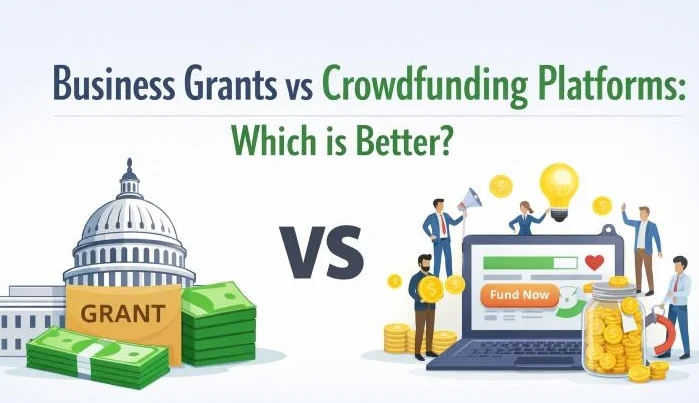
Raising capital is one of the hardest challenges for businesses and startups. Two popular non-loan options often come up: business grants and crowdfunding platforms. Both can provide funding without traditional debt. Both come with trade-offs that many founders overlook.
In 2026, the real question is not which option is popular. It is which option fits your business stage, risk level, and growth timeline.
This guide explains how business grants and crowdfunding platforms work, compares their real costs, and helps you decide which option makes more sense.
What business grants really offer
Business grants provide non-repayable funding when all conditions are met. There is no interest and no equity loss. This makes grants one of the safest forms of capital.
Grants are usually designed to support specific goals such as:
- Innovation and product development
- Business setup and early growth
- Equipment and technology
- Skills, training, and systems
- Sustainability and social impact
For businesses, grants act as risk-protection capital. They allow founders to build without immediate financial pressure.
The downside is structure. Grants are competitive, slow to approve, and restrictive in how funds can be used. Reporting and compliance are mandatory.
What crowdfunding platforms really offer
Crowdfunding platforms allow businesses to raise money from many individuals, usually online. Funding is not guaranteed, but successful campaigns can raise capital quickly.
Common crowdfunding models include:
- Reward-based crowdfunding
- Equity crowdfunding
Crowdfunding works best for consumer-facing products, creative projects, and brands with strong storytelling.
The main advantage is speed and validation. A successful campaign proves demand while raising funds.
The downside is effort and uncertainty. Campaigns require marketing, trust, and audience reach. Many campaigns fail to meet targets.
Business grants vs crowdfunding: direct comparison
| Factor | Business Grants | Crowdfunding Platforms |
|---|---|---|
| Repayment | None if compliant | None |
| Ownership loss | No | Possible (equity models) |
| Approval speed | Slow | Medium to fast |
| Funding certainty | Guaranteed if approved | Not guaranteed |
| Use of funds | Restricted | More flexible |
| Cash-flow pressure | Low | Low |
| Best for | Development and stability | Market validation and launch |
This comparison highlights a key difference.
Grants protect survival.
Crowdfunding tests demand.
When business grants make more sense
Business grants are usually the better option when:
- The business is early-stage or pre-revenue
- Repayment or dilution must be avoided
- Funding is for development, not marketing
- Time flexibility exists
- Administrative capacity is available
Grants are ideal for building foundations quietly and safely.
When crowdfunding platforms make more sense
Crowdfunding platforms are better when:
- The business has a market-ready product
- Customer interest can be demonstrated
- Speed matters
- Marketing and audience reach are strong
- Flexibility in spending is important
Crowdfunding is as much a marketing exercise as a funding tool.
The hidden costs many founders miss
Grants come with hidden time and compliance costs. Long approval cycles can delay launches. Reporting consumes resources.
Crowdfunding comes with hidden marketing costs. Campaigns require ads, content, and effort. Failed campaigns can damage confidence or brand perception.
Neither option is truly free.
The cost is paid in time, effort, or exposure.
Can grants and crowdfunding be used together?
Yes. Many smart businesses use both options in stages.
A common approach includes:
- Grants for development and setup
- Crowdfunding for launch and market entry
This reduces risk early and leverages public interest later.
Which option is cheaper in practice?
In financial terms, grants are cheaper because there is no repayment or dilution.
In practical terms, crowdfunding may be cheaper when speed and validation outweigh waiting time and compliance.
The cheaper option depends on timing, readiness, and execution capacity.
How to choose the right option for your business
Ask these questions honestly:
Is the funding for building or selling?
Can the business wait for approval?
Is there an audience ready to support a campaign?
Do I need flexibility or structure?
Clear answers guide the decision.
Final perspective
Business grants and crowdfunding platforms are not substitutes. They solve different problems.
Grants reduce risk and protect cash flow.
Crowdfunding validates demand and builds momentum.
The best funding strategy matches the tool to the business stage, not the hype.
Frequently Asked Questions (FAQ)
Are business grants better than crowdfunding?
Grants are safer and non-repayable, but slower. Crowdfunding is faster and validates demand, but success is not guaranteed.
Do crowdfunding platforms require repayment?
No. However, reward-based models require delivery, and equity models require ownership sharing.
Can startups use crowdfunding instead of grants?
Yes, if the product is market-ready and demand can be demonstrated.
Which option is faster to access funds?
Crowdfunding is usually faster than grants, but only if the campaign succeeds.
Are grants harder to get than crowdfunding funds?
Yes. Grants are competitive and rule-driven. Crowdfunding depends on audience reach and trust.
Can a business apply for grants after crowdfunding?
Yes, as long as grant rules allow it and expenses do not overlap.
Which option is better for early-stage businesses?
Grants are better for early development. Crowdfunding is better closer to launch.
Do crowdfunding platforms charge fees?
Yes. Most platforms charge platform and payment processing fees.