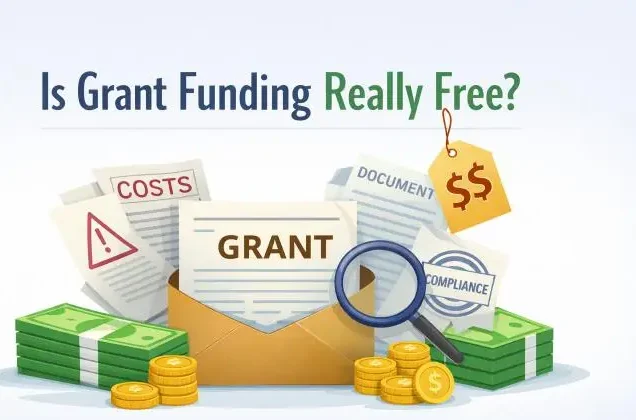
Grant funding is often described as free money. No repayment. No interest. No monthly pressure. For businesses, startups, and organizations, this sounds ideal. But in 2026, smart founders are asking a better question: is grant funding really free?
The honest answer is no.
Grants remove repayment risk, but they introduce other real costs that many applicants ignore.
This article explains the hidden costs of grant funding, how they affect businesses, and how to decide whether a grant is truly worth pursuing.
Why grants are called “free” in the first place
Grants are labeled free because they do not require repayment if all conditions are met. Unlike loans, there is no interest. Unlike investors, there is no equity loss.
From a balance-sheet perspective, grants are non-debt, non-dilutive capital. That makes them attractive, especially for early-stage or cash-constrained businesses.
However, money cost is only one part of funding cost.
The real meaning of “free” in grant funding
Grant funding is free financially, but not operationally.
To receive and keep a grant, recipients must:
- Apply competitively
- Follow strict rules
- Track spending
- Report outcomes
- Meet timelines
The cost shifts from repayment to time, compliance, and control.
1. Time spent applying
Grant applications consume significant time.
This includes:
- Researching eligibility
- Writing proposals
- Preparing budgets
- Submitting documents
- Responding to clarifications
For small teams, time spent on applications often replaces time spent selling, building, or operating.
Time has a real financial value.
2. Slow access to funds
Grants are rarely fast.
Approval cycles often take weeks or months. Disbursement may be delayed further.
If a business needs capital urgently, waiting for a grant can:
- Delay launches
- Miss market opportunities
- Increase operating pressure
The opportunity cost of waiting can exceed interest savings from avoiding a loan.
3. Restricted use of funds
Most grants are project-specific.
Funds usually cannot be used for:
- General operating expenses
- Emergency cash needs
- Flexible reallocations
- Unapproved purchases
This lack of flexibility can force businesses to find other funding sources anyway.
4. Compliance and reporting workload
Grant recipients must prove how funds are used.
This often requires:
- Detailed expense tracking
- Progress reports
- Outcome documentation
- Audits or reviews
Compliance consumes time and administrative resources. For small businesses, this burden can be heavy.
5. Performance and clawback risk
Grant funding is conditional.
If milestones are missed or rules are violated:
- Funding may be reduced
- Disbursements may stop
- Repayment may be demanded
This creates performance pressure, even without traditional debt.
6. Distraction from core business
Chasing grants can shift focus away from customers and revenue.
Businesses sometimes:
- Build projects to fit grants
- Delay revenue plans
- Over-prioritize funding over market demand
Funding that distracts from the core business can weaken long-term viability.
7. Limited scalability
Grants are limited by design.
They:
- Have capped budgets
- Serve specific goals
- Cannot scale endlessly
Grants are excellent for development and stabilization, but they rarely support rapid expansion.
When grant funding is truly worth it
Despite hidden costs, grants are still powerful when used correctly.
Grant funding makes sense when:
- Repayment risk must be avoided
- The project matches grant goals
- Timelines are flexible
- Administrative capacity exists
- Funding supports long-term value
In these cases, grants reduce financial risk significantly.
When grant funding is not the best option
Grants may not be ideal when:
- Capital is needed urgently
- Spending must be flexible
- Revenue growth is time-sensitive
- The team lacks compliance capacity
In these situations, the hidden costs outweigh the benefits.
How to use grants without regret
Smart businesses treat grants as strategic tools, not free cash.
Best practices include:
- Using grants for fixed or developmental costs
- Keeping revenue plans independent
- Avoiding over-reliance on grant cycles
- Budgeting time for compliance
- Measuring opportunity cost honestly
This approach preserves the value of grant funding.
The bottom line
Grant funding is repayment-free, not cost-free.
The real cost of grants is paid in:
- Time
- Flexibility
- Compliance
- Opportunity
For the right project, grants are one of the safest funding options available. For the wrong situation, they can slow growth and create frustration.
Smart founders ask not is it free?
They ask is it worth it for this stage of my business?
Frequently Asked Questions (FAQ)
Is grant funding really free money?
Financially, yes. There is no repayment if conditions are met. Operationally, grants require time, compliance, and strict use of funds.
What is the biggest hidden cost of grants?
Time. Application, reporting, and compliance can consume significant business resources.
Can grant funding ever require repayment?
Yes. If rules are violated or milestones are missed, repayment or clawbacks may occur.
Are grants cheaper than loans?
In monetary terms, yes. In opportunity cost terms, it depends on timing and flexibility needs.
Should startups rely only on grants?
No. Grants are best for development. Sustainable businesses rely on revenue over time.
Do grants slow down business growth?
They can, if approval delays or restrictions conflict with growth opportunities.
Are grants better than investors?
Grants avoid dilution, but investors offer speed, guidance, and scalability.
How should businesses decide whether to apply for a grant?
By comparing grant benefits against time cost, flexibility limits, and opportunity cost.