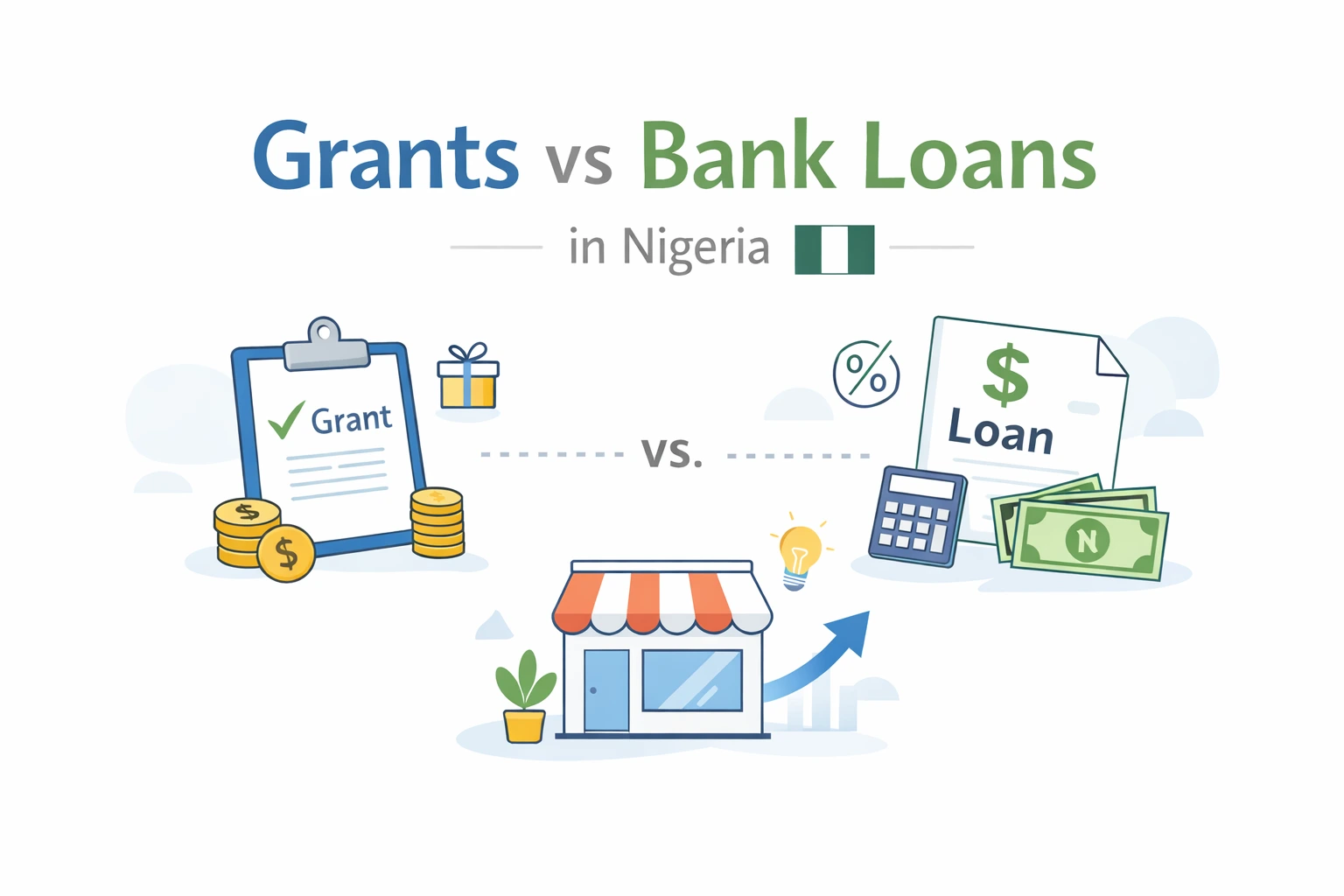
For many Nigerian small businesses, funding is the biggest growth barrier. Owners often face a hard choice between grants and bank loans. One promises non-repayable capital. The other offers faster access but comes with repayment pressure.
In reality, the decision is not emotional but It is financial. fact
In Nigeria’s 2026 business environment, funding costs go beyond interest rates. Inflation, cash-flow volatility, collateral demands, and repayment timing all matter. Choosing the wrong option can slow growth or collapse operations.
This guide provides a full cost comparison of grants and bank loans in Nigeria. It focuses on real financial impact, not marketing promises.
Why this comparison matters in Nigeria
Nigeria presents a unique funding landscape. Small businesses operate with high operating costs, unstable cash flow, and limited access to affordable credit.
Key realities include:
- High lending rates from commercial banks
- Strict collateral requirements
- Competitive and limited grant availability
- Cash-flow instability driven by market shocks
For many businesses, survival depends on selecting funding that matches financial reality, not ambition.
What grants really mean for Nigerian businesses
A business grant provides capital that does not require repayment if all conditions are met. Grants are often tied to development goals such as innovation, employment, agriculture, skills development, or enterprise support.
For Nigerian businesses, grants are attractive because they reduce financial pressure. There is no monthly repayment. There is no interest cost.
However, grants come with hidden costs.
Grant funding often requires:
- Long application timelines
- Strict eligibility screening
- Detailed reporting and documentation
- Restricted use of funds
Grants are best viewed as risk-reduction capital, not fast growth money.
What bank loans really mean for Nigerian businesses
A bank loan provides immediate access to capital, but at a cost.
In Nigeria, bank loans usually involve:
- High interest rates
- Fixed repayment schedules
- Collateral or guarantees
- Penalties for late repayment
Loans are attractive because they are faster than grants. They also allow flexible use of funds, including inventory, rent, payroll, and expansion.
However, loans introduce repayment pressure, regardless of business performance.
A slow sales month does not pause loan obligations.
Full cost comparison: grants vs bank loans in Nigeria
| Cost Factor | Grants | Bank Loans |
|---|---|---|
| Repayment | None if compliant | Mandatory monthly repayment |
| Interest cost | Zero | High over loan duration |
| Approval speed | Slow | Faster |
| Cash-flow pressure | Low | High |
| Flexibility | Limited use | Broad use |
| Financial risk | Low | Medium to high |
| Long-term impact | Stability | Growth with pressure |
This table shows the core difference.
Grants protect the downside.
Bank loans amplify both growth and risk.
The real cost of bank loans in Nigeria
Many business owners focus only on interest rates. This is a mistake.
The true cost of bank loans includes:
- Monthly repayment obligations
- Interest accumulation over time
- Collateral risk
- Cash-flow strain during low-revenue periods
For businesses with irregular income, loan repayments can force owners to divert working capital, delay salaries, or cut operations.
Even profitable businesses can fail due to poor loan timing.
The hidden cost of grants in Nigeria
While grants do not require repayment, they are not free.
Hidden grant costs include:
- Time spent applying
- Opportunity cost from delayed funding
- Compliance and reporting workload
- Restrictions on spending
For businesses that need immediate capital, waiting for grant approval can be more expensive than paying interest on a loan.
Time is also a cost.
When grants are the better option in Nigeria
Grants are the smarter choice when financial safety matters more than speed.
Grants work best for Nigerian businesses that:
- Operate with thin margins
- Cannot handle fixed monthly repayments
- Have long-term projects
- Can meet reporting requirements
- Do not need urgent capital
Grants are ideal for capacity building, equipment acquisition, innovation, and stabilization.
When bank loans are the better option in Nigeria
Bank loans work best when speed and execution drive revenue.
Loans are better for businesses that:
- Have predictable cash flow
- Can service repayments comfortably
- Need capital urgently
- Have clear revenue-generating plans
If funding will directly increase sales within a short period, loans may be justified despite higher costs.
The biggest mistake Nigerian businesses make
The most common mistake is overborrowing.
Many businesses take loans larger than they can comfortably repay. Others take loans without clear revenue plans. Some ignore worst-case scenarios.
Funding should never be based on optimism alone.
The second mistake is waiting too long for grants when operations need immediate cash.
Both mistakes are costly.
A smarter approach: mixing grants and bank loans
Many Nigerian businesses now use a combined funding strategy.
This involves:
- Using grants for equipment or systems
- Using smaller loans for working capital
- Applying for grants while operating with short-term loans
This approach spreads risk and protects cash flow.
It also reduces dependency on one funding source.
A simple decision framework
Before choosing, ask three questions:
Can my business survive repayments during slow months?
How fast will this funding generate revenue?
How flexible must spending be?
Clear answers lead to better decisions.
What banks and grant reviewers look for
Regardless of funding type, preparation matters.
Successful applicants usually have:
- Clear financial records
- Simple business plans
- Realistic cash-flow projections
- Defined use of funds
Funding favors clarity, not complexity.
Final insight for Nigerian business owners
In Nigeria, grants and bank loans are not equal. Each carries different costs and risks.
Grants protect cash flow but demand patience and discipline.
Bank loans provide speed but increase financial pressure.
The right choice depends on cash flow stability, urgency, and risk tolerance.
Funding should support business growth, not threaten survival.
Before committing, compare total costs, timing, and repayment impact. The best funding choice is the one your business can carry comfortably.