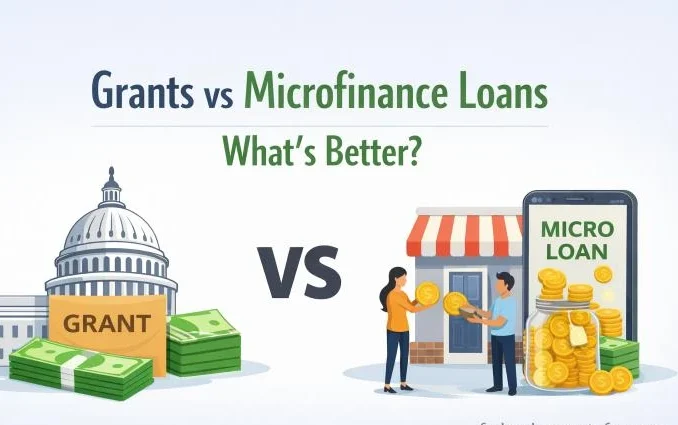
Small businesses and startups often face one key question: which funding option costs less, grants or microfinance loans? At first glance, grants seem free and microfinance loans come with interest. But the real answer is more nuanced. In 2026, businesses must consider total cost, cash-flow impact, speed, and compliance burden when comparing the two.
This article breaks down the true costs of grants and microfinance loans, explains hidden trade-offs, and helps you decide which option is genuinely cheaper for your situation.
What makes a funding option “cheaper”?
Cost is not just interest or repayment.
The real funding cost includes:
- Repayment obligation
- Interest and fees
- Cash-flow pressure
- Time to access funds
- Administrative and compliance burden
- Opportunity cost
A cheaper option is not always the one with zero interest. It’s the one that supports growth without threatening survival.
What a grant really costs
Grants are funds that do not require repayment if conditions are met. This makes them the lowest repayment cost option on paper.
But grants have real costs too:
- Time and effort spent applying
- Reporting, milestones, and compliance
- Restrictions on how funds can be used
- Long approval timelines
- Budget limits for eligible expenses
Grants protect cash flow and avoid debt. However, the time cost and compliance burden reduce their practical value.
For many small businesses, grants are cheap in terms of financial cost but expensive in terms of time and administrative effort.
What a microfinance loan really costs
Microfinance loans are small, short-term loans provided by microfinance institutions (MFIs), cooperatives, or community lenders. They often target small businesses and entrepreneurs who cannot access traditional bank loans.
Microfinance loans typically involve:
- Interest rates (higher than traditional bank loans)
- Processing and service fees
- Fixed repayment schedules
- Shorter terms
Though microfinance loan amounts are small, interest costs and fees add up quickly. Repayments create ongoing cash-flow pressure that can slow growth.
However, microfinance loans are often faster to access and more flexible than grants.
Grants vs microfinance loans: direct cost comparison
| Cost Factor | Grants | Microfinance Loans |
|---|---|---|
| Repayment obligation | None (if compliant) | Yes |
| Interest cost | Zero | Yes |
| Fees | Minimal | Processing & service fees |
| Cash-flow pressure | Low | Medium to high |
| Access speed | Slow | Fast |
| Administrative burden | High | Medium |
| Flexibility of use | Restricted | More flexible |
This table shows that grants are cheaper in monetary cost but may carry higher non-monetary costs.
When grants are cheaper than microfinance loans
Grants are the cheaper option when:
- Your business can wait for approval
- Your project fits strict funding categories
- Cash flow is unstable
- You want to avoid any repayment risk
- You can manage reporting and compliance
For capital-intensive but non-urgent needs—like equipment or systems upgrades—grants often make more sense.
When microfinance loans are cheaper in practice
Microfinance loans become cheaper when:
- You need funds immediately
- You cannot secure grants quickly
- Grant requirements do not match your project
- You have predictable cash flow
- Repayments align with revenue cycles
Microfinance loans can cost more in interest, but they save opportunity cost by unlocking growth faster.
For urgent working capital needs or quick marketing pushes, loans can be more practical despite their financial cost.
Hidden cost scenarios
Slow grant approval
Delays can cost growth opportunities. This is a real cost often overlooked.
Loan pressure
Monthly repayments reduce flexibility. In tight months, this means cutting spending elsewhere.
Compliance non-compliance
Failing to meet grant conditions can trigger clawbacks or penalties.
Overborrowing
Taking too much loan capital can create unnecessary interest costs.
Cheaper funding is not about picking the lowest rate. It’s about minimizing overall business stress and cost.
Can combining grants and microfinance loans reduce total cost?
Yes. Many smart businesses use a hybrid strategy.
For example:
- Grants cover long-term capital needs
- Microfinance loans support short-term working capital
- Loans are kept small to minimize interest
- Grants avoid debt for non-cash-flow-generating assets
This mix often results in a lower overall cost than using just one option.
How to decide which is cheaper for your business
Ask these questions:
Can I wait for funds?
Does the project generate revenue?
Is my cash flow stable?
Do I have the capacity to comply with grant reporting?
Can I handle monthly repayments?
If you answer “no” to repayment readiness and “yes” to patience and compliance capacity, grants are likely cheaper.
If you need capital urgently and have stable revenue, a microfinance loan may be cheaper in opportunity cost terms.
Final perspective
In pure financial terms, grants are cheaper because they avoid repayment and interest.
In practical business terms, “cheaper” depends on timing, opportunity cost, and cash flow impact.
Smart funding decisions consider both financial and operational costs, not just the absence of interest.
Frequently Asked Questions (FAQ)
Are grants always cheaper than microfinance loans?
In monetary cost, yes. But timing and compliance requirements can make loans more practical in some cases.
Do microfinance loans have hidden fees?
Yes. Many microfinance loans include processing, service, and administrative fees beyond interest.
Can a business get both grants and microfinance loans?
Yes. Combining funding often reduces overall cost and risk.
Why do microfinance loans cost more than bank loans?
Microfinance loans serve higher-risk, underserved businesses, so rates are higher.
Can grants fund daily operations?
Most grants restrict use to specific projects, not ongoing expenses.
Is waiting for grant approval a real cost?
Yes. Delays can stall growth opportunities and become expensive.
Are grants less flexible than microfinance loans?
Usually yes. Grants often limit how funds can be spent.
Should new businesses always choose grants?
Not always. If you need fast capital and have predictable revenue, microfinance loans may work better in practice.